
At CAB 2026, one question sat at the heart of our fireside discussion on Future-Ready Leadership: Talent, Technology and Transformation:
When a bank decides it needs to modernise, where does transformation risk actually begin?
The instinctive answer is often implementation. The point at which a new platform is configured, data is migrated, integrations are built and users begin testing.
But that is usually too late.
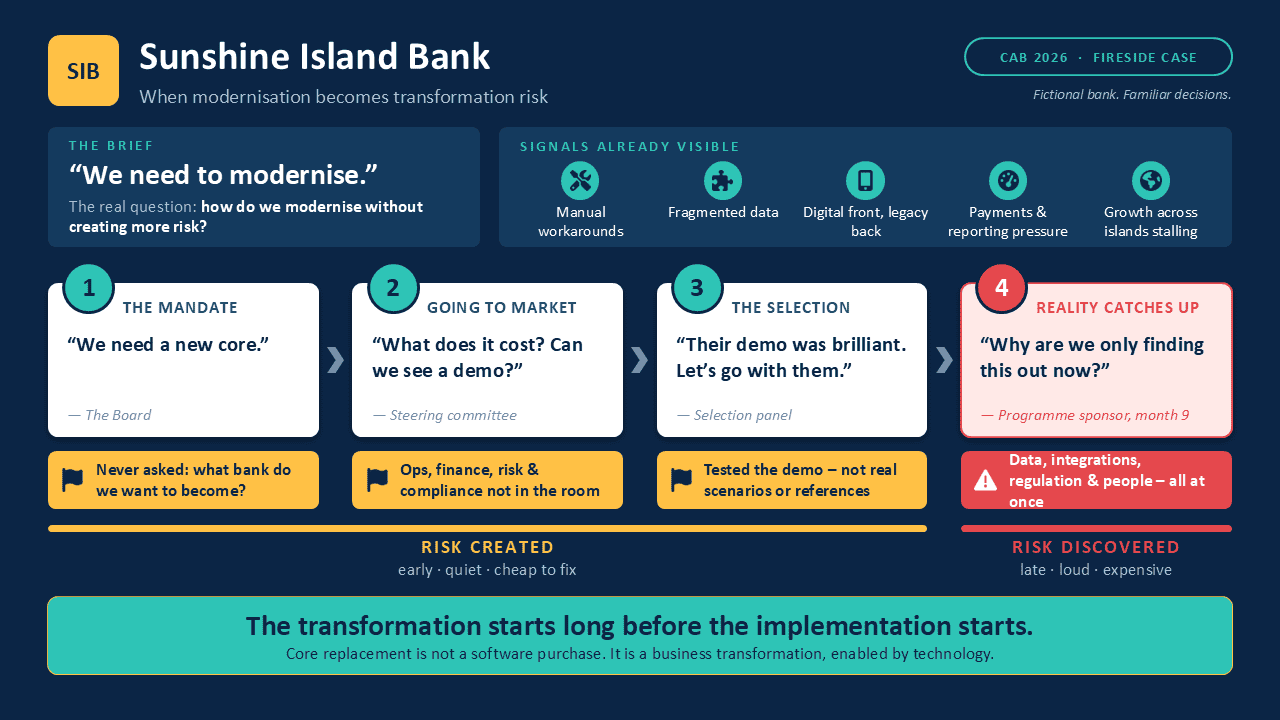
Using the fictional Sunshine Island Bank as a case study, Dr. Tanya McCartney and Adam Kasraoui explored a pattern many financial institutions will recognise.
The Board concludes that the bank needs a new core. The institution goes to market. Vendors are shortlisted. Demonstrations take place. One provider begins to build momentum.
Everything appears reasonable.
Then reality arrives.
Data is not as clean as expected. Integrations are more complex than first understood. Regulatory interpretations remain open. Critical business experts are unavailable because they are also responsible for running the bank. Requirements that appeared clear at the beginning look very different once real operational scenarios are tested.
The natural question becomes:
“Why are we only finding this out now?”
The more important question is:
“When did we first have the opportunity to find it out?”
That distinction matters.
Many of the risks that become visible during implementation were actually created months earlier, when the transformation was first defined.
Was the Board clear about what it wanted the future bank to become, or had it already jumped to the solution?
Were operations, finance, risk, compliance, lending and customer-facing teams involved early enough?
Had the institution separated genuine business requirements from inherited legacy processes?
Were vendors being evaluated against the bank’s real scenarios, or against the scenarios they chose to demonstrate?

And was qualification genuinely working both ways?
A responsible technology partner should not only be asking, “Can we win this opportunity?”
It should also be asking:
“Do we understand the outcome? Is the scope credible? Are the right people involved? Can we genuinely deliver what the institution needs?”
That is particularly relevant in the Caribbean.
Many banks in the region operate in environments where scale, regulatory complexity, regional expansion, multiple currencies, local market practices and limited specialist resources all have to be balanced carefully.
The same person needed in three transformation workshops this week may also be the person responsible for running lending, operations or compliance today.
Protecting that person’s time is therefore not simply a project-management decision. It is a leadership decision.
The same applies to vendor evaluation.
A polished demonstration can be impressive, but it is not evidence on its own.
Banks should control the scenarios that matter.
Show the normal transaction journey. Show the exception. Show what happens at end of day and month-end. Show the regulatory report. Show how the system behaves when something goes wrong. Then speak directly to institutions that have already gone through the journey.
Because the best demonstration is not necessarily the best solution.
Sometimes it is simply the best demonstration.
The central message from the discussion was therefore straightforward:
Core replacement is not a software purchase. It is a business transformation, enabled by technology.

For Caribbean institutions considering or already undertaking core modernisation, the most valuable work often happens before the contract is signed: defining the future operating model, aligning leadership, engaging the right people, understanding the data and integration landscape, and testing potential partners against the outcomes that matter.
Technology can enable transformation.
But it cannot compensate for an unclear strategy, unavailable people or decisions that have not been made.
And that is perhaps the most important takeaway:
The transformation starts long before the implementation starts.
For ERI, this is also the philosophy behind how we approach transformation with financial institutions. OLYMPIC Banking System provides an integrated, front-to-back and parameter-driven technology foundation supporting banks and financial institutions across core processing, onboarding, regulatory reporting, portfolio management, digital banking and wider financial operations.
But technology is only valuable when it is aligned to the institution it is there to support.
That is why the conversation should never start with the demo.
It should start with the bank.
Read more about our software solutions, or get in touch with Adam to find out more:

Adam KASRAOUI
Regional Sales Manager, ERI
Article by