
A perspective shaped by the Global WealthTech Summit 2026
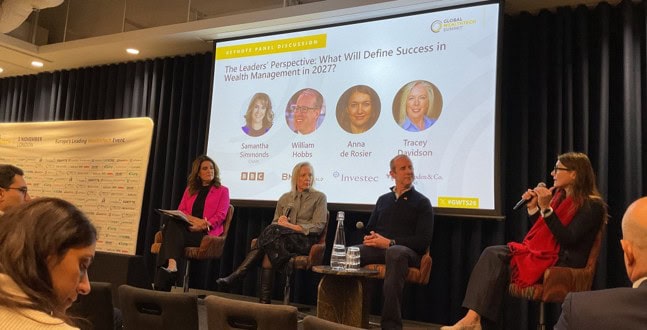
Opening keynote panel, Global WealthTech Summit, London.
The future of wealth management will not be decided by the most polished interface. It will be decided by the quality of the decisions, relationships and operations behind it.
What if the next great client experience is the friction clients never see?
Wealth managers are under pressure to look increasingly digital while remaining deeply personal. Clients want speed, a coherent view of their finances and effortless access to services. At the same time, they still want a person who understands the family, can explain a consequential decision and is accountable when something goes wrong.
Across four discussions at the Global WealthTech Summit in London, an underlying contradiction kept resurfacing. Firms invest in new channels, richer products and AI-assisted services, yet many still operate through fragmented data, manual hand-offs and control frameworks that sit outside everyday work. The front end can appear modern while the institution underneath remains hard to navigate.
The strategic question is therefore not simply which technology to buy. It is whether the firm can become more connected without becoming more complex, more scalable without becoming less accountable, and more automated without becoming less human.
The experience a client remembers is shaped by decisions and processes the client never sees.
Three tensions boards can no longer treat separately
| THE TENSION | THE REAL MANAGEMENT QUESTION |
| Personalisation versus scale | Where does automation release capacity for human judgement, rather than merely reduce contact? |
| Breadth versus fragmentation | Can banking, investments, liquidity and advice work together without forcing the client to connect the dots? |
| Innovation versus control | Can the firm change quickly while preserving an auditable, coherent record of decisions and transactions? |
This paper develops seven propositions and a practical executive agenda. It is a synthesis of themes raised at the event, not a claim that the industry has already settled the answers.
Trust is not the alternative to technology. It is the outcome.
The opening leaders panel resisted an easy story about technology replacing relationships. Access to investment information has never been easier. Portfolio construction and basic market exposure are more accessible and subject to sustained fee pressure. Yet when clients need to commit capital, respond to market stress, finance a property or plan for the next generation, the conversation often returns to a trusted professional.
That does not mean clients wish to return to paper processes or inflexible service models. A younger beneficiary may expect an intuitive mobile experience and still want a knowledgeable person when family circumstances become complicated. Existing clients may prefer familiar forms of contact but expect much faster responses. The human element persists; the job around it changes.
The relationship manager of the future should spend less time compiling information and more time interpreting it, challenging assumptions and joining financial decisions to a client's life. In that sense, technology does not shrink the human proposition. Used well, it can raise the standard of what a human conversation must deliver.
The premium shifts from information to context
If clients can obtain commentary, compare fees and research products independently, generic information becomes harder to charge for. What retains value is applying expertise to their particular balance sheet, family situation, risk capacity and objectives, then remaining available when circumstances change.
The unresolved issue for providers is not whether clients want a human or a machine. It is how to reserve meaningful human time for the moments that justify it, without creating a two-tier experience in which a sizeable group of clients receives fragmented or impersonal service by default.
The client has one financial life. Institutions often see many.
A client does not experience cash, investments, credit, custody and planning as separate operating divisions. These are connected choices within a single financial life. But the systems holding balances, exposures, suitability information, instructions and relationship history are frequently distributed across institutions, departments and partners.
The panel on serving the whole client described the disconnect plainly: providers may work hard to make the experience seamless, but the coordination behind the scenes remains difficult. As clients become more affluent, they often accumulate more advisers, banks and specialist relationships. Repeated requests for the same information become an unmistakable symptom of fragmentation.
Consider a client who wants short-term liquidity without selling long-term investments. Good advice may require a view across cash balances, collateral eligibility, portfolio concentration, borrowing costs, tax implications, repayment capacity and execution. No single product screen resolves that decision. The quality of service depends on the integrity of the information and on whether responsibilities across the relationship are clear.
A unified experience does not require owning every service
Some firms will extend their in-house proposition. Others will deliberately partner for tax, specialist planning or lending. Neither model is automatically superior. A connected experience depends on explicit accountability: who owns the client relationship, who can access and correct information, who executes the transaction and who remains responsible for the outcome?
Clients should not have to become integration specialists to use their own financial services.
The deeper challenge is a governance issue, not just a connectivity issue. Data rights, consent, incentives to share information and a trusted hand-off between organisations matter as much as the technical interface.

Cost to serve is becoming a growth strategy
The debate about fees is often framed as a challenge to the traditional wealth proposition. A more consequential question is what level of service can be delivered economically, and to whom. Lower-cost investment exposure has moved the benchmark. At the same time, onboarding, periodic reviews, transaction processing and reporting still consume significant operational capacity.
AI-assisted research and document gathering are starting to change that equation. Participants described practical uses such as assembling onboarding information and preparing client research so that professionals can concentrate on investigation, analysis and decisions. The objective is not simply doing the same work with fewer people. It can be reaching more clients with appropriate depth of service while keeping controls and quality intact.
This distinction matters because efficiency without an improved client outcome is a fragile success story. An automated onboarding step that creates more exceptions downstream is not truly cheaper. A relationship manager handling more accounts while losing the ability to understand them is not necessarily more productive. The useful unit of analysis is the full client journey, from first contact to ongoing servicing.
What should a firm measure?
Time from enquiry to account readiness. Repeated data capture. Manual corrections between operations and advisory teams. Time required to assemble a reliable whole-client view. Exceptions requiring escalation. Adviser capacity available for substantive contact. These measures show whether lower cost to serve is compatible with better outcomes, rather than disguising complexity elsewhere in the business.
Stop asking only: one platform or best-of-breed?
The technology-stack discussion at the summit challenged a familiar false choice. Firms do not succeed because they choose a single platform, nor because they assemble the maximum number of specialist tools. The better question is which capabilities must remain coherent and authoritative, and which can safely evolve as replaceable services.
A newer entrant described deliberately designing for multiple custodians and currencies from the outset. An established operator highlighted the hidden costs of migration, parallel running, local regulation, duplicated expertise and user adoption. Both perspectives point to the same reality: architecture is an operating-model decision with long-lived commercial consequences.
A firm can be locked into a single supplier. It can also be locked into a web of integrations that nobody can fully change. The former concentrates dependence; the latter distributes it. Neither risk disappears merely because the software is branded modern, cloud-enabled or API-first.
A more useful architecture conversation
| DESIGN QUESTION | WHAT A CREDIBLE ANSWER LOOKS LIKE |
| Where is the authoritative record? | Clear ownership for accounts, transactions, holdings and client data, with reconciled boundaries to other systems. |
| What must be interchangeable? | Well-defined interfaces and contracts for specialist tools, channels and partners, including portability and exit. |
| What does change really cost? | Lifecycle economics that include migration, dual-running, testing, controls, training and subsequent enhancements. |
| Can it support tomorrow? | An operating model that can adapt to new products, custodians, entities, markets and service channels without rebuilding the foundation. |
The objective is not one application for everything. It is one coherent way of executing the financial activities a firm is responsible for, while retaining room to collaborate with specialists. Standardised data and predictable interfaces are strategic assets because they preserve choice.
AI makes the data problem more urgent, not less.
The conference produced two very different pictures of AI. In one, it frees staff from searching documents and compiling information. In another, increasingly capable agents build software, assist with credit decisions and may eventually communicate directly with a financial provider on a client's behalf. Both possibilities are real areas of experimentation. Neither eliminates the need for sound operational data and human accountability.
A speaker discussing an experimental AI credit assistant described it proposing an implausible way for a client to fund a purchase. The anecdote was not evidence that all AI credit tools fail. It illustrated a harder problem: a fluent answer can still miss context, judgement and suitability. The most convincing-sounding response is not necessarily the responsible one.
AI may also reshape client acquisition. Clients can arrive at meetings with AI-generated research, product comparisons and conclusions. Several speakers noted the risk of mistakes or similar-looking outputs. If automated summaries become a prominent first point of contact, firms will have to communicate their value clearly enough to be understood by both people and machines.
What does "AI-ready" actually mean?
It means source information that is timely and traceable; permissions appropriate to the task; rules for when an output requires review; a record of the advice or action taken; and accountable owners when something goes wrong. Data quality becomes more than an IT concern once software can act on that data.
AI can make weak processes run faster. That is not the same as making the institution smarter.
A sensible approach is to start with tasks whose outcomes can be checked, such as document preparation, reconciliation support or meeting research, and advance to higher-impact decisions only as evidence, control and responsibility mature. The ceiling for autonomy should be set by the consequences of error, not simply the sophistication of the model.
Compliance should shape the action, not queue behind it.
The "Business of Yes" keynote offered a counterpoint to the conventional view of compliance as an obstacle. In cross-border wealth management, delays often arise because advisers must navigate fragmented policy documents, geography-specific interpretations and manual legal or compliance queues. The point was not to weaken controls. It was to make them available closer to the moment a business decision is being made.
For example, a firm might want to know whether an adviser can contact a client in a particular jurisdiction, offer a specific product or distribute a piece of marketing material. If the answer arrives long after the opportunity has moved on, control has become a bottleneck by design. If appropriately maintained rules can be applied within the workflow, the same control objective may become faster and more consistently evidenced.
The keynote also raised the need to supervise newer communication channels and AI-driven workflows. A secure transactional platform is not, by itself, a complete answer to messaging supervision, cross-border policy interpretation or monitoring of AI agents. Those specialised functions require their own rule sources, evidence and governance, connected to the processes in which business activity occurs.
Speed needs defensibility
The important qualities are not merely a fast answer, but an answer that can be traced to the applicable policy, legal entity, client and proposed action, and reviewed after the event. Version control, audit trails, exception handling and clear human escalation are the ingredients of controlled speed. Automation that cannot explain its basis risks replacing a visible queue with an invisible one.

The operating model is the real transformation.
A new platform cannot make colleagues collaborate if incentives reward information hoarding. An API cannot resolve disagreement about who owns the client relationship. A data warehouse cannot establish which of two conflicting records should be trusted. These are leadership, process and governance choices, even when technology can help implement them.
Speakers discussing acquisitions and platform replacement stressed the practical importance of understanding existing workflows, comparing the technologies of both parties and involving staff in design and adoption. They also described the temptation to impose one organisation's systems on another without first asking what the other organisation does better.
The most valuable operating model is neither endlessly centralised nor chaotically federated. It assigns responsibility clearly, makes information available with appropriate permissions and allows each team to understand how its decisions affect the client beyond its own boundary.
Human effort should be spent on clients, not stitching systems together
Relationship managers often become the human glue across organisational gaps. Their resourcefulness can mask poor processes for years. Modernisation succeeds when it moves that coordination from individual heroics into repeatable, transparent workflows, without stripping the relationship manager of judgement or discretion.
Five decisions for the 2027 board agenda
The most useful response to the conference is not to commission another digital front-end project in isolation. It is to ask a sequence of tougher questions about the relationship, the operating foundation and the evidence of progress.
|
DECISION |
QUESTION TO TAKE INTO THE BOARDROOM |
|
1. Define the human premium |
Which moments require judgement, reassurance or challenge, and are we giving people time for them? |
|
2. Trace one client journey |
Where do clients repeat information, experience avoidable hand-offs or lose visibility across services? |
|
3. Set architecture principles |
Which financial records and controls must remain coherent? Which specialist capabilities should stay replaceable? |
|
4. Prove one controlled AI use case |
What measurable outcome improves, what data is used, who validates the result and how can it be audited? |
|
5. Measure outcomes, not launches |
Are errors, delays and friction falling while capacity, confidence and quality rise? |
A credible transformation programme starts with these choices, then makes technology accountable to them. It does not treat implementation as evidence of success.
The industry does not need another promise of seamlessness. It needs a more reliable way to deliver it.
Where OLYMPIC Banking System fits in this conversation
The themes above point to a practical requirement: financial institutions need dependable operational foundations if they are to offer broader, more connected client services without multiplying complexity. A compelling digital experience is difficult to sustain when the underlying records and processes cannot keep pace.
ERI's OLYMPIC Banking System is designed for that foundational role. It is a configurable, real-time, front-to-back banking and wealth management platform supporting connected activities across client relationships, banking, investments and financial operations. Its scope includes capabilities for onboarding and CRM, accounts and payments, foreign exchange, lending, portfolio and order management, securities and custody-related processing, and associated operational and accounting workflows.
OLYMPIC Banking System supports multi-entity, multi-currency and international operating requirements. Its modular, service-oriented design and interfaces allow institutions to establish a coherent core while connecting external channels and specialist applications where those are the right choice. That matters for firms whose service models cut across jurisdictions, asset classes and multiple forms of client relationship.
No platform, including OLYMPIC Banking System, can substitute for the responsibility of an adviser, the judgement of a compliance professional or the expertise of a specialist planning partner. Nor should an integrated core be confused with a complete AI governance, cross-border legal or communications-surveillance solution. Those functions must be evaluated on their own merits, with clear integration and accountability.
The more enduring opportunity is to make the operational foundation reliable enough that professionals can focus on what technology alone cannot deliver: relevance, perspective and trust.
The future of wealth management is not just a better screen. It is a better-connected institution behind it.
Read more about our software solutions, or get in touch with Adam to find out more:

Adam Kasraoui
Regional Sales Manager, ERI
Article by